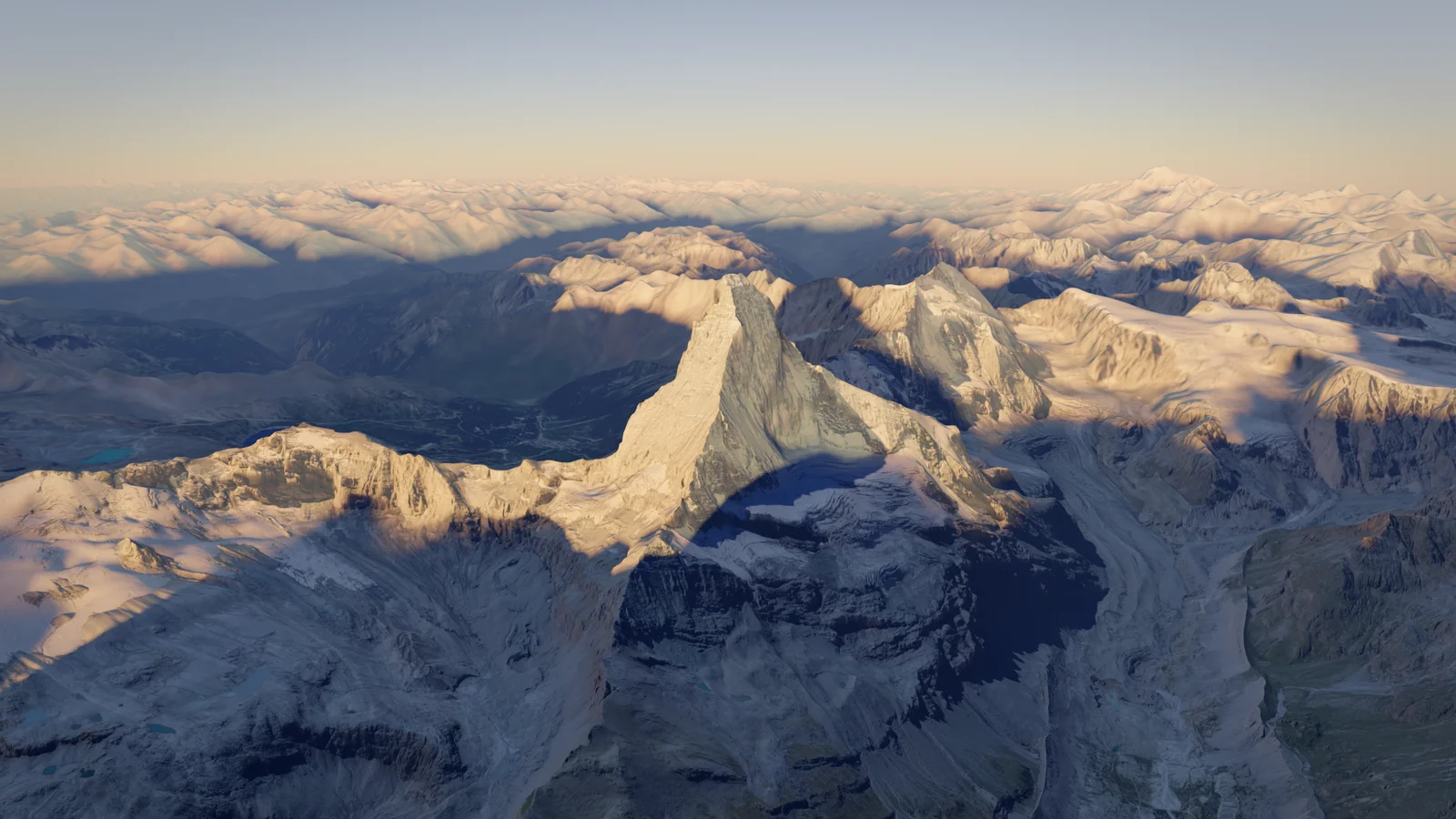
Matterhorn
4,478 m
Switzerland, Italy
Also known as Матерхорн, Μάττερχορν, +4Also known as
Матерхорн · Μάττερχορν · Cervino · Cervin · მატერჰორნი · Маттерхорн
- Elevation
- 4,478 m
- Prominence
- 1,043 m
- Difficulty
- 6/10
- Alpine climb
- Best Season
- Jul–Aug
- Routes
- 2
Routes
2The Swiss normal route: 1,220 m of long, exposed and loose-in-places ridge climbing from the Hörnli Hut, mostly UIAA I–II with III- on the Moseley Slabs and fixed ropes on the steepest steps. Route-finding and pace, not technical difficulty, decide success; the descent is as long as the ascent.
Elevation Profile
approximate line- Distance
- 5.9 km
- one way
- Ascent
- +1,950 m
- −60 m lost on the way up
- High Point
- 4,478 m
- Time Up
- 7h 22m
- DIN 33466
- Time Down
- 4h 50m
- DIN 33466 · same way back
Day one: from Zermatt take the gondola to Schwarzsee (2,583 m) and walk about 2 hours up the marked path along the Hörnli ridge to the Hörnli Hut (3,260 m); the last section has fixed ropes, chains and metal steps. Many parties walk the first part of the climb in daylight the evening before, because the lower ridge is hard to follow in the dark. Day two: parties leave the hut before dawn. Fixed ropes lead up the first step, then the line weaves across the east face, crossing the first, second and third couloirs on ledges and short steps, rarely on the crest itself. Above the old hut site (about 3,750 m) a rib leads to the Lower Moseley Slab and the Solvay Hut (4,003 m), reached in roughly 3 hours. The Upper Moseley Slab (III-) leads back to the ridge, past the Lower Red Tower to the Shoulder, then up long fixed ropes to the snow and ice of the summit roof, which usually needs crampons, to the Swiss summit (4,478 m). The Italian summit with the iron cross lies a little further along the summit ridge. The hut puts the ascent at 4–5 hours and warns that the descent, by the same route, is longer and harder. Most parties downclimb, abseiling only at a few stations (Moseley Slab, the Gebiss), because abseiling the whole ridge snags ropes and causes rockfall on the parties below. Rock off the trodden line is very loose: if the holds are not polished and scratched, you are off route.
Start
Schwarzsee2,587 m
- Zermatt–Furi–Schwarzsee gondola (summer)
- Train to Zermatt (Matterhorn Gotthard Bahn via Visp, or shuttle train from Täsch), then the Zermatt Bergbahnen gondola via Furi to Schwarzsee.
Stages
| Day | Stage | km | m ascent | m descent | Time |
|---|---|---|---|---|---|
| 1 | Schwarzsee → Hörnlihütte | 4.1 | 701 | 29 | 2h 55m |
| 2 | Hörnlihütte → Matterhorn | 1.8 | 1,246 | 31 | 4h 26m |
Waypoints
- Lift: Schwarzsee2,587 m
Top station of the Zermatt–Furi–Schwarzsee gondola
- Hut: Hörnlihütte3,263 m
- Bivouac: Solvay Hut4,004 m
Emergency shelter only
- Summit: Matterhorn4,478 m
Key Passages
- Fixed ropes on the first step above the Hörnli Hut
- First, second and third couloirs on the east face
- Lower and Upper Moseley Slabs (III-) around the Solvay Hut
- Lower Red Tower and the Shoulder
- Fixed ropes above the Shoulder
- Summit roof (snow/ice, crampons)
Equipment
0/12 packedDownloads
Route confidence 86%Overview
The 4,478 m pyramid on the Swiss–Italian border above Zermatt and Breuil-Cervinia. Both normal routes are long, exposed rock ridges with fixed ropes rather than glacier walks, and success depends on speed, route-finding and dry, cold conditions.
The Matterhorn (Cervino in Italian, Cervin in French) stands alone at the head of the Mattertal and the Valtournenche, its four faces aligned roughly with the compass points and its ridges dropping 1,000–2,000 m to the glaciers below. Zermatt sits to the north-east, Breuil-Cervinia to the south. It is one of the most climbed 4,000 m peaks in the Alps, and on a good summer day up to about 100 people set out from the Hörnli Hut.
The Swiss normal route, the Hörnli (north-east) Ridge, is graded around AD with short UIAA III- steps, and the Italian Lion (south-west) Ridge is a little steeper and more heavily equipped with fixed ropes. Neither crosses a glacier, but both involve 1,200 m or more of exposed climbing on rock that is loose wherever it is not worn by traffic, with snow and ice on the upper ridge for much of the season. The descent by the same route takes as long as the ascent, and most accidents happen on the way down.
Rockfall has become the dominant concern. Thawing permafrost and snow-poor summers have destabilised the faces: in July–August 2026 guides on both sides suspended guided ascents after rockfalls, many of them triggered by climbers above, and the Italian side was closed by ordinance in August 2022. Neither route was officially closed in 2026, but conditions should be checked with the local guides' offices before every attempt.
Climbing Notes
You need to be comfortable moving quickly and unroped or on a short rope over exposed UIAA II–III ground, with and without crampons, for 8–12 hours. Aim to reach the summit within about 4–5 hours of leaving the hut; slower parties are routinely turned back by guides. Prepare with long rock ridges and at least four or five days of acclimatisation, including nights above 3,000 m and one or two other 4,000 m peaks (the Breithorn or peaks in the Monte Rosa massif are typical). Zermatt guiding offices offer a preparatory training climb, typically on the Riffelhorn, for clients whose readiness is uncertain.
Most people climb with an IFMGA guide, usually one client per guide, and the Hörnli Hut recommends this. The typical itinerary is: gondola from Zermatt to Schwarzsee, 2 hours up to the Hörnli Hut, a pre-dawn start, summit and back to the hut, then down to Zermatt the same day. From Italy, plan two days: Breuil-Cervinia to the Carrel hut (6–7 hours), then summit and descent. Book the Hörnli Hut early (reservations open in April for the following summer) and the Carrel hut through the Cervinia guides. Avoid hot spells with a very high freezing level; dry, cold conditions after a period of stable weather are best.
Check current conditions with the hut and the guides' offices: since 2022 rockfall has led to closures (Italian side, August 2022) and to guides suspending ascents (both sides, July–August 2026).
History
The Matterhorn was one of the last major Alpine peaks to be climbed. Edward Whymper's party (Lord Francis Douglas, Charles Hudson, Douglas Hadow, Michel Croz and Peter Taugwalder father and son) reached the summit by the Hörnli Ridge on 14 July 1865. On the descent Hadow slipped and pulled Croz, Hudson and Douglas off; the rope broke and the four fell to their deaths down the north face. Three days later, on 17 July 1865, Jean-Antoine Carrel and Jean-Baptiste Bich reached the summit from Breuil by the Lion Ridge. Lucy Walker became the first woman to climb it in 1871, and Franz and Toni Schmid made the first ascent of the north face in 1931. Several hundred climbers have died on the mountain since 1865. The Hörnli Hut, first built by the Swiss Alpine Club in 1880, was rebuilt and reopened on 14 July 2015 for the 150th anniversary of the first ascent.
Season
Best Jul–Aug- January: Not advisable
- February: Not advisable
- March: Not advisable
- April: Not advisable
- May: Not advisable
- June: Possible
- July: Best (best window)
- August: Best (best window)
- September: Good
- October: Possible
- November: Not advisable
- December: Not advisable
- Jan
- Winter ascents only for very experienced alpinists; huts unstaffed
- Feb
- Winter conditions
- Mar
- Winter conditions
- Apr
- Winter conditions
- May
- Ridges still snow-covered; huts closed
- Jun
- Hörnli Hut opens late June; upper ridge often still snowy
- Jul
- Main season; watch for rockfall in heat waves
- Aug
- Main season; very busy; rockfall risk rises when the freezing level is high
- Sep
- Often good, quieter conditions; Hörnli Hut closes mid to late September
- Oct
- Huts closed; early snow and short days
- Nov
- Winter conditions
- Dec
- Winter conditions
Access & Permits
- Hut Booking
- Hörnli Hut: online via hoernlihuette.ch or +41 27 967 22 64 / info@hoernlihuette.ch; reservations open on 1 April for the coming summer and the hut is often full for the whole season. Capanna Carrel: info@guidedelcervino.com (Società Guide del Cervino).
- Fees
- Hörnli Hut: CHF 150 per person per night in a dormitory with half board; CHF 50 per person per night is non-refundable on cancellation
- Hörnli Hut: sleeping-bag liner mandatory, CHF 43 if bought at the hut
- Zermatt–Schwarzsee gondola ticket
- Rules
- The Solvay Hut (4,003 m) on the Hörnli Ridge is an emergency shelter only and must not be used for planned overnight stays
- Hörnli Hut: own food may not be eaten in the hut; tap water is not drinkable
- Capanna Carrel on the Lion Ridge: overnight reservation mandatory through the Società Guide del Cervino (since 2019)
- Rockfall closures happen: the Italian side was closed by ordinance in August 2022 (climbers rescued during the closure were charged rescue costs and fined); in July–August 2026 Swiss and Italian guides suspended guided ascents and strongly discouraged all climbing
- Zermatt is car-free: private cars must be left in Täsch or earlier
- Getting There
Zermatt (Switzerland); Breuil-Cervinia (Italy) for the Lion Ridge
Geneva (GVA) or Zurich (ZRH) for Zermatt; Milan Malpensa (MXP) or Turin (TRN) for Breuil-Cervinia
- Zermatt: train via Visp to Zermatt; by car, park in Täsch and take the shuttle train to Zermatt
- Zermatt Bergbahnen gondola Zermatt–Furi–Schwarzsee (summer), then about 2 hours on foot to the Hörnli Hut
- Breuil-Cervinia: train to Châtillon-Saint-Vincent, then bus up the Valtournenche; road access by car
- 4WD taxi from Breuil-Cervinia to the Rifugio Duca degli Abruzzi all'Oriondé
Hazards
- Rockfall
- Altitude
- Exposure
- Weather
Huts & Shelters
4- 2,802 m
Rifugio Duca degli Abruzzi all'OriondéRefuge
Summer only (roughly late June/July to mid-September)
- 3,260 m
HörnlihütteHut
150 beds · Late June to mid/late September (2027 season announced as 25 June – 18 September); emergency room open outside the season
- 3,830 m
Capanna Jean-Antoine CarrelBivouac
25 beds · Unstaffed; booking mandatory; reopened 4 July 2026 pending completion of a replacement hut
- 4,003 m